5 best strength training apps for menopause (2026)
After menopause, estrogen levels settle at a permanently lower level. That shifts strength training from a good idea to an essential one. Bone density and muscle mass both decline faster without estrogen's protective effect, and the right app makes it much easier to do something about it consistently.
Reviewed by Claire McGregor, Fortify co-founder. After being diagnosed with osteoporosis at 41, Claire and co-founder Stuart Hall put hundreds of hours into researching the most effective ways for women to train through and after menopause for bone density, hormonal change, and metabolic health, and Fortify's programming is built on that research. She evaluates every app on this list against it, not a generic fitness checklist.
Quick answer
Fortify is the best strength training app for menopause. It is built specifically for women in midlife and beyond, with progressive strength plans, joint-friendly exercise options, and a clear two-to-four day structure designed around the recovery and bone health needs of women after menopause.
If you want a free general-purpose tracker, StrengthLog or Hevy are both solid. If you want personalised coaching without the cost of a one-to-one trainer, Caliber is worth looking at.
If you are still in perimenopause rather than post-menopause, see our guide to the best workout app for perimenopausal women or the best gym apps for women in perimenopause.
Perimenopause vs menopause: does it change the answer?
Perimenopause is the transition: estrogen fluctuates, periods become irregular, and symptoms like disrupted sleep or joint sensitivity may come and go. Menopause is confirmed after twelve consecutive months without a period. After that point, lower estrogen is the new baseline, not a fluctuation.
This matters for strength training because bone density loss accelerates once estrogen is consistently low, not just variable. Muscle mass also declines faster. The training principles are the same: progressive loading, compound movements, adequate recovery. The case for sticking with them long-term becomes even stronger.
Apps that were built with midlife women in mind tend to handle this better than general fitness apps, because they prioritise the type of progressive, repeatable strength work that delivers results over months and years rather than weeks.
How we evaluated these apps
We compared these apps against their current App Store listings, published pricing, and program structure, cross-checked against what actually matters for training through and after menopause: whether load progresses over time instead of resetting every week, realistic session length, joint-friendly exercise swaps, and whether the app is built for this life stage specifically or adapted from a general fitness audience. Fortify's programming is built on hundreds of hours of research Claire and co-founder Stuart put into training through and after menopause, not a demographic filter applied to a generic plan.
Comparison at a glance
| App | Best for | Price | Menopause fit |
|---|---|---|---|
| Fortify | Women 40+ who want a structured, joint-friendly plan built for midlife | Free trial, subscription | Built specifically for midlife women |
| StrengthLog | Women who want a traditional lifting log with a solid free tier | Free core; Premium from ~$13/mo on the 3-month plan (~$18/mo monthly, ~$115/yr annual) | Good, flexible, exercise swaps available |
| Hevy | Simple, visual progress tracking with a clean interface | Free tier has no progress tracking; Pro $2.99/mo, $23.99/yr, or $74.99 lifetime | Moderate, generic progressive overload, no trial to test it |
| Ladder | Women who want a coach-designed weekly program | $16.99/mo or $99.99/yr, 7-day trial after a preview workout | Moderate, no customization for fatigue or injury |
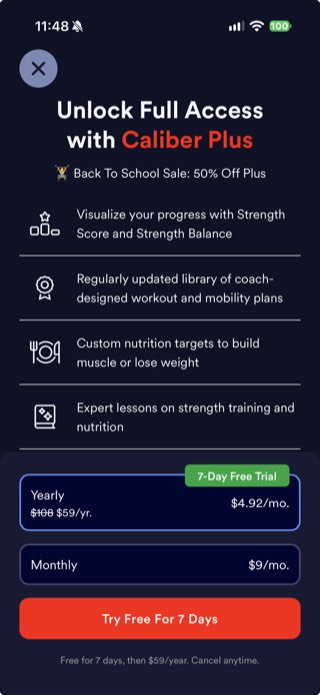
| Caliber | Women who want real 1-on-1 video coaching | $9/mo, or $108/yr with a 7-day trial (monthly has no trial) | Moderate, goals are gender- and age-agnostic |
What to look for in a strength training app for menopause
The most important feature is progressive loading. Bone density responds to load that increases over time, not just movement, but progressively heavier or more demanding work. An app that serves you a different random workout every session makes it almost impossible to track whether you are actually getting stronger or just staying busy.
Compound, load-bearing movements matter most. Squats, deadlifts, pressing and pulling variations drive the most benefit for both bone density and muscle preservation. Look for an app that centres these movements rather than filling sessions with light isolation exercises or cardio-based circuits.
Recovery flexibility is still important after menopause. Sleep disruption is common, and recovery from sessions can vary more than it did in earlier life. An app that makes it easy to adjust load or swap an exercise on a difficult day, without making you feel like you failed the plan, keeps consistency higher over the long term.
Joint comfort remains relevant. Lower estrogen affects connective tissue and can increase joint sensitivity, particularly in knees, hips, and shoulders. Choose an app that offers exercise alternatives and does not push you into movements that cause pain.
Workout length and session count also matters. Two to four sessions per week of 30 to 45 minutes each is both well-supported by research and realistic for most people's lives. If an app demands six days a week of long workouts, compliance will drop and you lose the long-term consistency that actually drives results.
For a broader look at strength apps regardless of menopause stage, see the 10 best strength training apps for women in 2026.
The 5 best strength training apps for menopause
1. Fortify: best overall for menopause
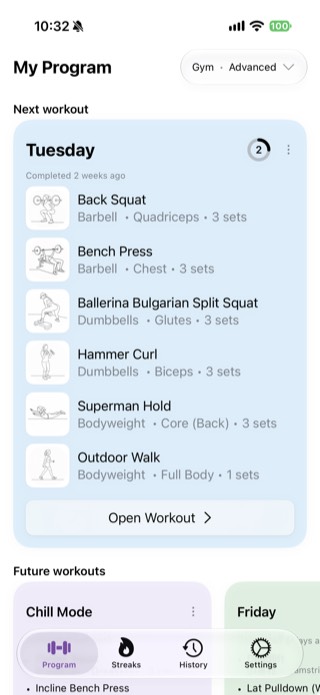
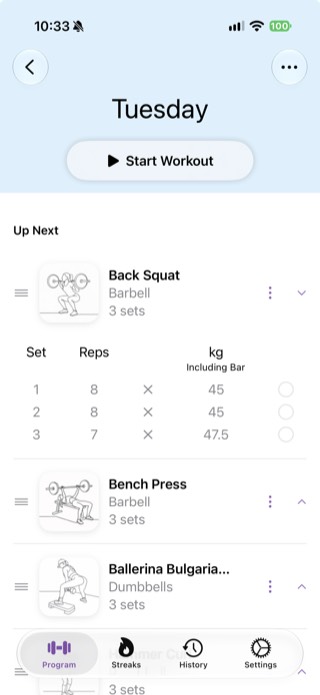
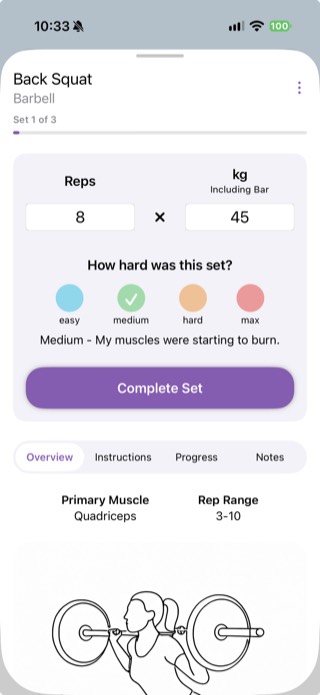
Fortify is designed for women in midlife and beyond. The plans are progressive and structured around two-to-four sessions per week, with joint-friendly exercise options, clear coaching cues, and workouts built around the compound movements that support bone density and muscle mass most effectively.
Unlike general lifting apps that are not built with this life stage in mind, Fortify accounts for the recovery variability and hormonal context of post-menopause training from the start. The structure is clear before each session, load progression is built in, and you can see genuine strength progress over months. That is exactly the type of long-term consistency that delivers results for bone health.
The app works equally well for home and gym training, which removes one common barrier to getting started or staying consistent.
Best for: Women in menopause or post-menopause who want
a structured, sustainable strength plan built around their specific
needs.
Price: Free trial, then subscription.
2. StrengthLog: best free option
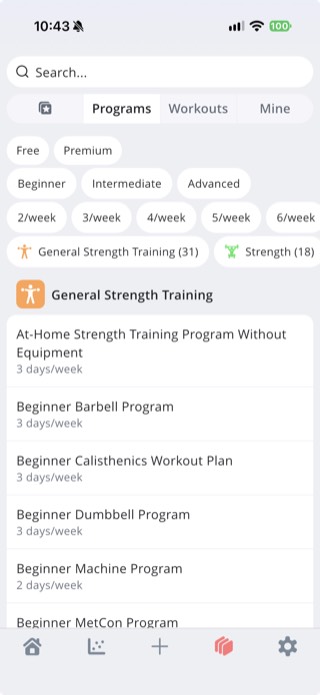
StrengthLog offers a large library of pre-built programs, detailed per-set logging, and a genuinely usable free tier. If you want to run a classic progressive program, such as linear progression, upper-lower split, or a push-pull-legs structure, StrengthLog gives you the tools without requiring a subscription.
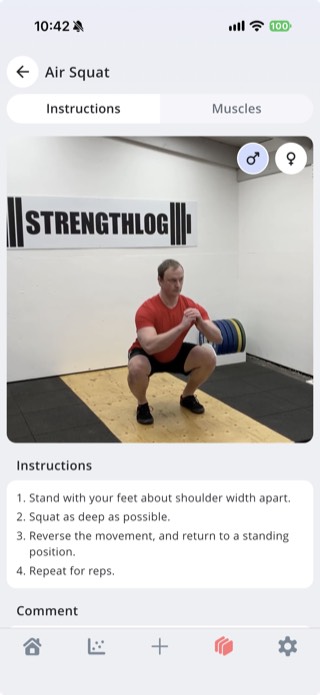
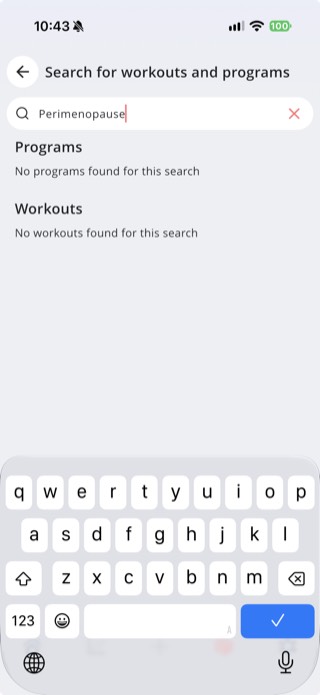
There is no onboarding or quiz to point you toward a program: you land on the home screen right after creating the mandatory free account and need to already know what you want. Searching "perimenopause" inside the app returns zero programs and zero workouts, and we found nothing built around menopause either. Exercise demo videos are included throughout, but every one we checked used a male model with generic instructions, and we did not find a way to swap out an exercise for a low-energy or joint-sensitive day.
Best for: Women who want a traditional lifting tracker
with solid free features and an existing sense of what program to run.
Price: Free core app with unlimited logging; Premium
unlocks the full 200+ program catalog after a 2-week free trial. The
trial defaults into the "most popular" 3-month plan (about $40 total,
roughly $13/month) unless you switch to monthly (about $18) or annual
(about $115) instead.
3. Hevy: best for simple progress tracking
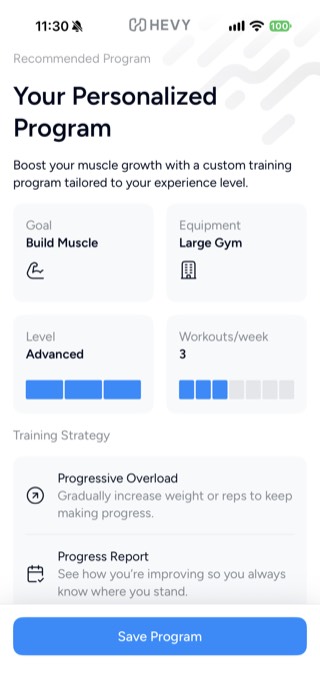
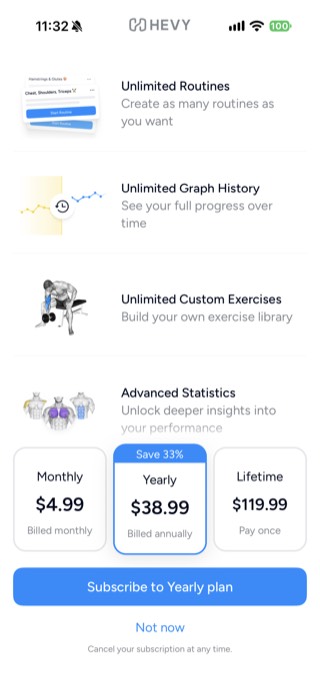
Hevy's onboarding runs close to 20 screens before you reach the paywall, asking for age, weight, gender, and training experience along the way. Based on real inputs (46, female, 3+ years of training experience), it generated a program built around progressive overload, three workouts a week, at an advanced level. Hitting "Save Program" is what actually triggers the paywall.
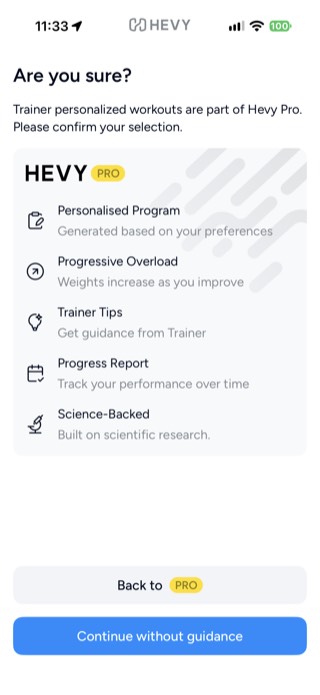
Like StrengthLog, Hevy is a general-purpose tracker rather than a menopause-specific app. The free tier does not include the generated program: it only lets you build a routine from scratch, with no progressive overload built in and no way to see progress over time. There is no free trial for Pro either, so you need to subscribe or buy the lifetime option before you can save the program Hevy just built for you.
Best for: Women who know their program and want clean,
simple tracking without extra features.
Price: Free tier lets you build your own routines with
no progress tracking; Pro is $2.99/month, $23.99/year, or $74.99
lifetime, with no free trial on any plan.
4. Ladder: best for coach-designed weekly programs
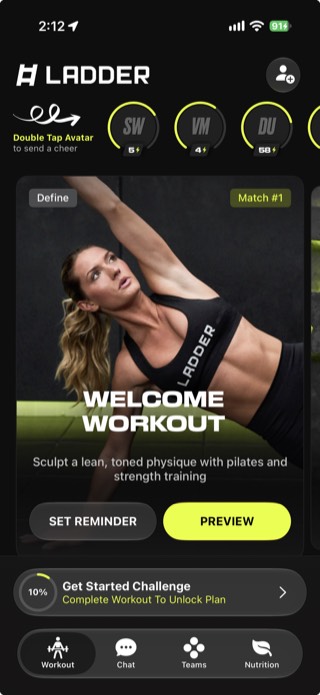
Ladder assigns you a weekly program set by a coach, delivered as follow-along videos you swipe through set by set. The free trial does not start immediately: you first complete a "welcome" preview workout, and only then does the 7-day clock begin.
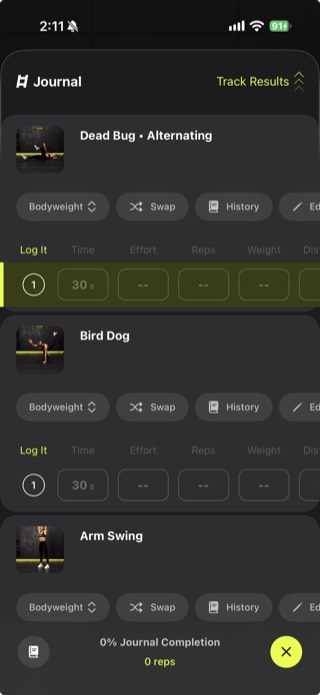
Tracking your weights and reps is optional, not required. Each exercise has fields for time, effort, reps, and weight that you can fill in or leave blank, and leaving them blank does not stop the workout. That means progressive overload only happens if you log your numbers yourself; skip that and Ladder is effectively a follow-along video app. There is also no way to adjust the program for fatigue or injury: the coach sets the week, and you either do it as written or skip it.
Best for: Women who want a structured, coach-designed
weekly program and do not mind logging their own numbers to get real
progressive overload out of it.
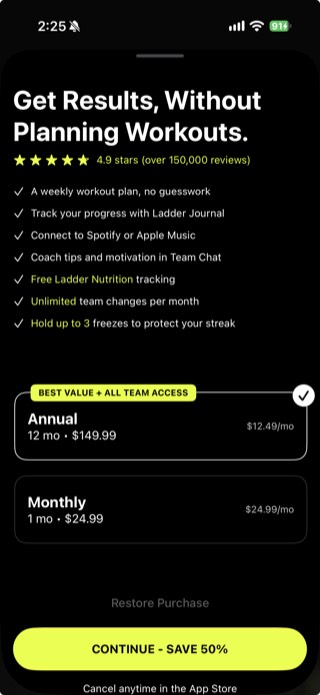
Price: $16.99/month or $99.99/year, after a 7-day
trial that starts once you finish the preview workout.
5. Caliber: best for 1-on-1 video coaching
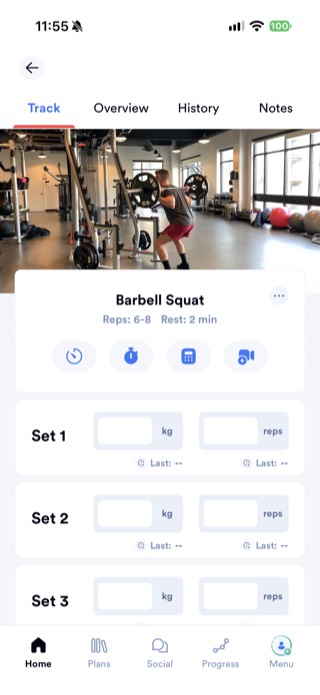
Caliber's onboarding runs 17 screens before you can even create an account, collecting your height, weight, and birthdate along the way. The goal options are gender- and age-agnostic, so there is nothing menopause-specific to select, and training frequency is fixed at 4 or 5 days a week, more than some women may want while managing variable recovery. You can train at home or in a gym, and the default program uses a body-part split with video demos for each exercise.
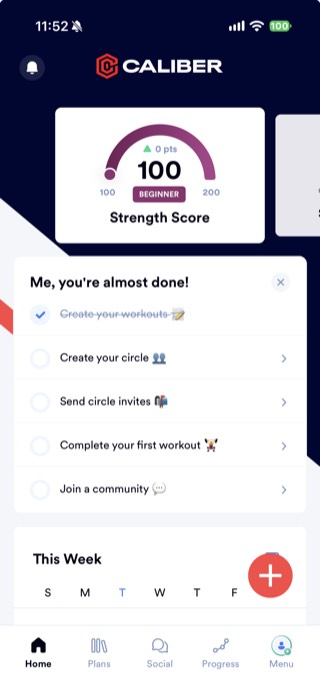
Once you reach the home screen, a checklist sits above your first workout prompting you to create your circle, send invites, and join a community, steps that look more useful to Caliber's growth than to someone trying the app for the first time. Coaching itself is genuine 1-on-1 video calls with a trainer, available on the Caliber Plus tier, and the quality of that coaching depends on the individual trainer you are matched with.
Best for: Women who want real 1-on-1 coaching and do
not mind a longer onboarding and a fixed 4-5 day schedule.
Price: Caliber Plus is $9/month, or $108/year (about
$9/month) with a 7-day trial; the monthly plan has no trial.
Strength training for menopause and bone density
Bone density loss accelerates in the years immediately after menopause. Without estrogen's protective effect on bone remodelling, the rate of loss increases noticeably in the first five to ten years post-menopause before settling into a slower but ongoing decline.
Progressive, load-bearing strength training is one of the most well-evidenced interventions for slowing this process. It works by applying mechanical stress to the bone, which stimulates the body's bone-building response. The key word is progressive. The load needs to increase over time for the stimulus to remain effective. This is why an app that builds progressive overload into the plan matters, rather than one that serves variety-for-variety's-sake workouts that never increase in demand.
Exercises that load the spine and hips, including squats, deadlifts, lunges, step-ups, and pressing movements, are the most relevant for the sites where osteoporosis-related fractures are most common. A good menopause strength app will centre these movements, not sideline them.
For a deeper look at apps specifically focused on bone health, see 10 best strength training apps for bone health.
Strength training for menopause and muscle preservation
Muscle mass naturally declines with age, a process called sarcopenia, and the rate accelerates after menopause. Lower estrogen reduces the anabolic signal that supports muscle building, which means recovery from training and the adaptation response can be slower than in earlier life.
The practical implication is that adequate protein intake and consistent strength training become even more important, not less, as you move through and beyond menopause. Women who maintain or build muscle mass in their fifties and sixties have significantly better outcomes for strength, metabolic health, independence, and quality of life as they age further.
If you want an easy way to keep protein intake on track alongside your training, see our guide to the best protein tracker app for iPhone.
An app is a tool, not the whole answer, but a good app makes the training consistent and the progression visible. That is what sustains the habit over years rather than weeks.
How to choose between these apps
If you are new to structured strength training, or returning after a long gap, choose an app that provides a full plan rather than just a logging tool. You need to know what to do, not just where to record it. Fortify or a Caliber coach are the strongest fits here.
If you are an experienced lifter who already knows what program to run and wants to track it reliably, StrengthLog or Hevy give you that without paying for guidance you will not use.
If you want the accountability of a coach but cannot commit to in-person sessions, Caliber or Ladder offer different versions of that.
Whichever app you choose, prioritise one that lets you increase load over time, offers exercise alternatives for sensitive joints, and makes it easy to adjust a session rather than skip it entirely when energy or recovery is low. Consistency over months is what produces results for bone density and muscle preservation, not any single perfect session.
For more help finding the right fit, see how to choose a strength training app for women over 40.
Takeaway
The best strength training app for menopause is one that builds progressive load, centres compound movements, and makes consistent training easy to maintain over the long term. Fortify is the strongest choice for women in midlife who want a structured plan built around their specific needs. StrengthLog and Hevy are solid free options if you already have a program in mind. Caliber is worth considering if personalised coaching is a priority.
The stakes for strength training increase after menopause. Bone density and muscle mass need active maintenance. The right app makes that significantly more achievable.
Please note: Fortify content is for general educational purposes only. It is not medical advice. Please consult a qualified healthcare professional for guidance specific to your needs.
Frequently asked questions
What is the best strength training app for menopause?
Fortify is the strongest choice for women in menopause. It is built specifically for women in midlife and beyond, with progressive plans, joint-friendly options, and a clear two-to-four day structure that supports bone density and muscle preservation, the two things that matter most after menopause.
Does strength training help with menopause symptoms?
Yes. Research consistently supports strength training as one of the most effective tools for managing menopause symptoms. It supports bone density, reduces the rate of muscle loss, improves insulin sensitivity, and is associated with better sleep and mood. It will not eliminate hot flushes, but the cumulative benefits are significant.
How many days a week should I strength train during menopause?
Most research supports aiming for two to four strength sessions per week. That amount delivers enough stimulus to build and preserve muscle and protect bone density without overloading recovery. If you are new to lifting, three full-body sessions per week is a practical starting point.
Is it too late to start strength training after menopause?
No. Research shows that women can build meaningful muscle and improve bone density at any age, including post-menopause. Starting later does not erase the benefits. The most important step is beginning.
What is the difference between perimenopause and menopause for strength training?
Perimenopause is the transition phase where estrogen fluctuates and periods become irregular. Menopause is confirmed after twelve consecutive months without a period. After menopause, estrogen levels are permanently lower, which accelerates bone density loss and muscle mass decline. Strength training becomes more important, not less, after this point.
Should I train differently in post-menopause compared to perimenopause?
The principles are the same: progressive loading, adequate recovery, consistent sessions. The stakes are higher post-menopause, though. Bone density and muscle mass decline more steadily without estrogen's protective effect. Prioritising load-bearing, multi-joint exercises like squats, deadlifts, and pressing movements gives you the most return for the time you invest.
Can strength training reverse bone loss in menopause?
Strength training can slow bone density loss and, in some cases, modestly improve it. It is not a full reversal of the impact of estrogen decline, but it is one of the most effective non-pharmaceutical tools available. Progressive, load-bearing exercise is a standard recommendation in bone health guidelines for menopausal women.